Liquid Gold From Argan Nut
“May you live 100 years with all the wealth and wellness”, is the traditional way of blessing in India. Hope, Argan tree has been blessed twice as its estimated life span is more than 200 years. Argan is dotingly called as the ‘Tree of life’ by the Moroccan populace and is awarded with the title ‘Liquid gold’, for its innumerable healing benefits.
Cherished and kept as a beauty secret by the women of Morocco since 12 B.C., Argan oil has made a clean sweep of the cosmetic and medicinal streams with its natural potent to treat enormous skin conditions, hair problems, rheumatism, diabetes, cardiovascular disorders and many other health conditions.
Being one among the oldest extant trees on earth dated back to the Tertiary period, Argan oil is recommended in the Complementary and Alternative Medicine for treating acne, stretch marks, wrinkles and other aging symptoms, dandruff, rough and dry hair, high cholesterol levels, inflammatory conditions and more.
Ayurveda recommends Argan oil for treating pitta dosha vitiations like acne, boils, skin inflammation, blemishes, microbial infections, digestive disorders along with vata problems including dry, scaly skin, wrinkles, fatigue, anxiety, constipation and frizzy hair conditions.
Purchase Argan Oil – Retail – 2 oz – CLICK HERE
Purchase Argan Oil – Retail – 4 oz – CLICK HERE
Purchase Argan Oil – Wholesale – CLICK HERE
 Chemical constituents and therapeutic values of Argan oil:
Argan oil is cold pressed from the seed kernels of the Argan fruit and is rich in fatty acids including oleic acid, alpha-linoleic acid, palmitic acid, stearidonic acid, linoleic acid and myristic acid along with tocopherols, carotenes, phenols (present in Argan oil are resorcinol, caffeic acid, vanillic acid, oleuropein, catechol, epicatechin, catechin and tyrosol.)
Since the traditional times, Argan oil is admired as a promising source of vitamin E, vitamin A, unsaturated fatty acids along with Omega 6 and Omega 9 fatty acids (has antioxidant properties).
All these constituents contribute to the remedial properties of Argan oil. They are antioxidant, moisturizing, cicatrisant, cardiovascular, hypolipidemic, aphrodisiac, anti-rheumatic, anti-aging, anti-acne, hepatoprotective, immune stimulant, anti-obesity, anti-sebum, anti-proliferative (cancer preventive), choleretic and anti-diabetic.
Historical uses and importance of Argan oil:
Argania spinosa is the botanical name of the Argan tree that belongs to the Sapotaceae plant family. Indigenous to Morocco, the conical or oval bulb-shaped fruits possess the magical seed or the nut holding the nourishing oil-rich kernels.
Even today, in this mechanized world, the extraction of Argan oil is regarded as the most complex method that any oil can be extracted. In an economically poor setup, the Berber women involve in the toiling and long-drawn-out work of extracting oil from the kernels. The fruit pulp is often used as a cattle feed, followed which the nut is cracked open to reach the kernels.
The disheartening news is that Argan tree is one among those endangered species, mainly due to deforestation, drought and inappropriate extensive use. The primordial native women of the Amazigh community were among the oldest populace to use edible Argan oil.
The edible Argan oil is a part of the scrumptious habitual breakfast of the Moroccans, where home-made bread varieties are complimented with honey and Argan oil. It is also taken with a different combination, along with fresh salads and goat cheese. The authentic Moroccan sweet Amlou is a much-relished aphrodisiac with a blend of almonds, Argan oil and honey.
Morocco sets right the best examples of Argan oil employment, especially for topical applications, in the treatment of acne, eczema, psoriasis, joint pain, dry skin, inflammatory skin conditions and wrinkles. People of various Moroccan tribes used Argan oil as a preventive aid for frizzy hair and hair fall.
UNESCO has enlisted Argan tree in the World Heritage record and utters, “Argan tree is not only the focus for conservation, but also for research and socio-economic development. Traditional uses of the Argan tree are for example forestry, pastoralism, food, medicine and cosmetics. Growing along the border of Sahara, it also functions as a buffer against desertification.”
Ayurvedic health benefits of Argan oil:
Anything and everything that is a part of nature comes under the Ayurvedic roof. This is because Ayurveda, the knowledge of life strongly states that everything on earth is a part of Mother Nature and is made up of the five vital forces of Nature.
Ayurvedic philosophy states that the origin of all existing things on earth is the real consciousness called as Purusha. It states that energy and matter are the same, where energy is evident through the 5 vital elements namely earth, fire, water, air and space. These elemental forces lay a foundation for all matters in the universe.
In the human body earth is present in the physique like muscles, bones, cartilages, tendons, skin, hair and nails. Space exists in digestive tract, lungs, thorax, mouth and the abdominal area.
Fire is instituted in the process of metabolism, vision, intellect and body temperature. Air is evident in heart palpitations, muscular movements, nervous and respiratory functions. Water endures in the form of blood, digestive juices, functions of the salivary glands, cytoplasm and mucous membranes.
Known as Panchamahabhutas, these five elements entail the functions of the five senses. The sense of touch, sight, sound, smell and taste match up accordingly with air, fire, space, earth and water.
These 5 vital elements combine to form the 3 doshas or the biological energies of nature, namely vata (space + air), pitta (fire + water) and kapha (earth + water). According to the Ayurvedic principle, every individual is made up of a combination of three doshas with a predominance of any one dosha. This predominance determines the personality, spirit and the behavioral patterns.
Every person is treated in a distinctive manner based upon his/her Prakriti or the unique individual constitution and Vikruti or the state of health. Balance between these doshas indicates a healthy state whereas doshic imbalances end up in illnesses.
Ayurvedic treatment involves the natural remedies and techniques for striking proper balance between the doshas. According to this remedial system, health encompasses the wellness of the mind, body and spirit, also known as Swasthya.
More than a healing methodology, Ayurveda is a way of living that embraces spirituality, philosophy, and science. It aims at diagnosis, prevention of illnesses, healthy aging, self-realization and longevity.
For attaining this freedom of living and blissful aging, Ayurveda treats the individual (not the disease) by recommending herbal medicines, Ayurvedic essential oils, Dinacharya or Ayurvedic routine, yoga, simple physical exercises, Pranayama or conscious breathing, Panchakarma or cleansing technique, prayers and meditation (to connect with the Divine energy).
The Ayurvedic health benefits of Argan oil are:
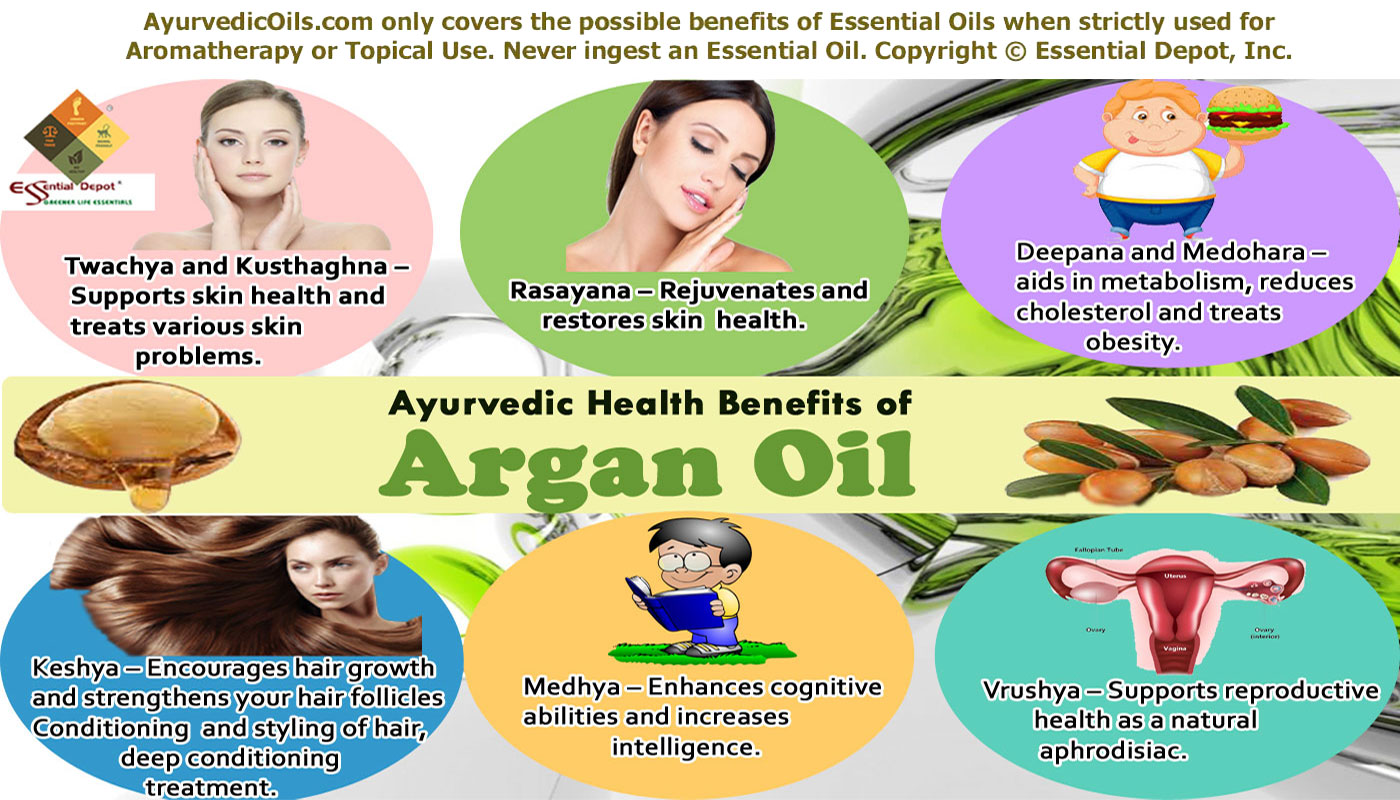 1. Twachya and Kusthaghna – Supports skin health and treats various skin problems:
Integrating the Ayurvedic essence of the Eastern provinces with the nurturing herbs of the Western world is indeed an enlightening experience.
Argan oil is such a nourishing, moisturizing and enriching oil for the skin, for which it can be honored as Twachya, meaning a remedy that backs up healthy skin and as Kusthaghna for its effectiveness in repairing various skin damages and healing numerous skin conditions.
The rich presence of tocopherols, squalene, carotenes, sterols and phenolic antioxidants from its vitamin E, vitamin A, Omega 6, Omega 9 and unsaturated fatty acids make Argan oil, the best ever oil on earth for skin in the pink.
It is effective for all the three types of skin:
i. Dry, rough and scaly vata skin – With its moisturizing, nourishing, emollient and circulatory properties, Argan oil pampers your skin by kicking out dryness and leaving it supple and soft. It is one among the trusted remedies to mend itchy, flaky and rough skin.
ii. Sensitive, broken and inflammatory pitta skin – Argan oil is an excellent anti-inflammatory and antimicrobial oil that can support in treating boils, irritating and acne-prone skin, cracks, burns and repair inflamed skin conditions.
Mr. Majda Alaoui Sosso, Director of Morocco’s oil cooperative said, “Recent scientific studies have showed benefits of Argan oil has antimicrobial properties, and can be used in treating damaged skin and inflammation.”
iii. Oily, puffy and thick kapha skin – Kapha based skin has a natural tendency to secrete excess sebum from the sebaceous glands of the skin. This greasy, oil-like secretion helps to retain the moisture and elasticity of the skin.
Over-secretion might end up in oily skin, acne, blemishes and dullness. Argan oil has active anti-sebum property that regulates the secretion of sebum.
A 2007 study on “Clinical and instrumental study of the efficacy of a new sebum control cream” by Dobrev H, Department of Dermatology, Medical University, Plovdiv, Bulgaria, tested the effectiveness of a sebum control cream containing Argan oil. Topical application of this Argan oil based cream on 20 healthy volunteers for 4 weeks reveals an evident sebum-regulating effect in about 95 percent of the participants.
This study concludes that the Sebum control cream with Argan oil shows efficacy in “reducing the greasiness and improving the appearance of oily facial skin.”
It works on suppressing surfeit fat cells and reduces water retention, which might otherwise end up in leaving the skin thick and puffy.
Argan oil has been in use for more than thousands of years in healing wounds, cuts, sores, burns, and acts as a protective layer for your skin from harmful UV (ultra-violet) rays, pollution, change in weather conditions, stress and other environmental factors.
Gently massaging your skin in slow circular motion with 2 drops of Argan oil, 1 drop of Tea tree oil and 1 drop of Evening primrose oil can help in reducing acne, inflammation, acne marks, chicken pox scars, rashes, eczema, boils, repairing damaged skin cells and in preventing microbial infections from spreading all through skin surface.
This tranquilizing massage also helps in regulating the pH balance of the skin and supports in locking the natural moisture in it. The presence of vitamin E, linoleic acid and other nutrients in Argan oil aid in boosting cellular production.
2. Rasayana – Rejuvenates and restores skin health:
Argan oil is absolutely a Rasayana in Ayurvedic terms, mainly due to its anti-aging, rejuvenative, tonic, circulatory and regenerating properties. It aids in restoring the skin health that has turned thick, dry, inflamed, mature and aged skin with wrinkles, fine lines, blemishes and other aging symptoms.
The phenolic antioxidants along with the presence of Omega 6 and Omega 9 fatty acids contribute to its free radicals scavenging activity. Free radicals are often the terrible cause behind the symptoms of aging.
The oil of Argan extracted from its seed kernel is an excellent skin toner with exfoliating qualities that can discard dead skin cells, tone the cellular structure, tightens the skin cells, influences the replenishment of new skin cells and guards skin elasticity by supporting the collagen production.
Collagen is the essential protein in the body that supports the strength of the connective tissues and grants that natural cushioning effect for various parts of the body.
Massaging your system with 5 drops of Argan oil blended with 4 ounce of Jojoba oil can do all that is required to retain your youthful looks and leave you look like ‘you’re 16 even at 36.’
This aids in moisturizing dry feet, hands, heels, cracked lips, stretch marks, hyperpigmentation disorders, wrinkles and in granting that glossy look to your nail and cuticles.
3. Deepana and Medohara – aids in metabolism, reduces cholesterol and treats obesity:
Argan oil is a Deepana, which aids in strengthening the digestive system and is a Medohara that assists in reducing cholesterol and deal with obesity.
Massaging your abdomen with 3 drops of Argan oil with 2 drops of Peppermint oil can help in enhancing the secretion of pepsin, digestive enzymes and other gastric juices.
This aids in supporting metabolic functions and promote quicker digestion and proper bowel movements. The gentle properties of Argan oil also helps in soothing the lining of the stomach and intestinal walls.
Argan oil has antioxidant properties and the potent to enhance HDL – good cholesterol and reduce LDL – bad cholesterol with the presence of phenolics and phytosterols that contribute to its hypocholesterolemic activity. This helps in enhancing heart health and in treating cardiovascular disorders and obesity.
Polyphenols, sterols and tocopherols are antioxidant components present in Argan oil. This helps in treating cellular damage and according to certain studies; Argan oil reduced the rate of cellular division, especially in prostate cancer conditions with its antioxidant, antiatherosclerotic and hypocholesterolemic properties.
A 2008 study on ‘Effect of Argan oil on platelet aggregation and bleeding time: A beneficial nutritional product’ by Mekhfi H, Bnouham M and Gadi D states, “Argan oil prevents thrombin- or epinephrine-induced platelet aggregation. Argan oil can reduce platelet aggregation, therefore minimizing the risk of thrombosis in cardiovascular event.”
4. Keshya – Encourages hair growth and strengthens your hair follicles: Conditioning and styling of hair, deep conditioning treatment.
“Argan oil has an amazing oil balance feature which hydrates dry hair and spreads and balances excess in oily hair. The oil can leave a beautiful shine without any greasiness and aims to reduce the impact of environmental pollution,” says Sangeeta Mahimtura, technical director of Juice.
She also adds, “Argan oil also hydrates and nourishes. It regenerates your cells thus strengthening the hair and its elasticity and increasing its growth. When used on skin it can make ugly marks, spots and acne disappear. This oil can also protect your skin from early aging which can be caused due stress, pollution, sun and chemicals. It adds shine and has a calming effect on flyaway and frizzy hair and significantly detangles the hair, reducing blow-dry time.”
Argan oil is a rich source of Vitamin E, which is predominantly recognized to help with the ducts or the growth of capillaries on the skin and scalp. This helps in cascading the therapeutic values along with natural nutrients of Argan oil and also supports proper blood circulation. And! The result is strong, healthy and voluminous hair.
With its natural emollient and moisturizing properties, Argan oil works as a conditioner and a repairing serum that works wonders in treating frizzy hair, split ends, dandruff, itchy and flaky scalp conditions.
Gently massage your scalp and hair (especially the ends), by starting from the roots and extending to the length with 2 drops of Argan oil blended with 2 drops of Ylang Ylang oil, 2 drops of Tea tree oil and 1 ounce of coconut oil. Leave it overnight by covering your head with a shower cap.
Wash your hair in the morning with ½ drop of Argan oil mixed with your mild shampoo. That’s it and you are perfectly ready with those soft, shiny, silky, detangled and bouncy locks.
You don’t need a conditioner anymore and you’d love to have your hands on your hair, just to keep caressing them.
5. Medhya – Enhances cognitive abilities and increases intelligence:
Argan oil is a Medhya herb in Ayurvedic terminology for its potent to stimulate the functions of the brain, cognitive performance, memory power, positive thinking and treat mood fluctuations.
‘Rosemary is there for remembrance’ is an encouraging phrase for all those wonderful people in the world, involved in an effort for greater achievements. Argan oil joins the queue with Rosemary oil in augmenting your cognitive performance and improved functions of the mind.
Argan oil has the same 1,8-cineole, the proven active constituent in Rosemary that has been proved as an effective contributor for Rosemary oil’s improved cognitive abilities. This is substantiated by the research conducted by Lorraine Oliver and Mark Moss, the Brain, Performance and Nutrition Research Center, Northumbria University, UK.
This study states that ‘1-8-cineole present in Rosemary oil’ was candidly associated with the enhancement of the cognitive function in the 20 volunteers who were a part of the experiment. It concludes “the compounds absorbed from rosemary aroma affect cognition and subjective state independently through different neurochemical pathways.”
Blend 1 drop of Argan oil and 1 drop of Rosemary oil and rub soothingly on your temples and wrist to alleviate headache, loss of memory, mood fluctuations, tension, lethargic attitude, stress, lack of motivation, feelings of loneliness and low self-confidence and self-esteem.
1 drop of Argan oil and 5 drops of Rosemary oil added to your bath is an excellent way to trigger a uplifting, new-fangled and a great day with full of positive energy to just get-up-and-go!!!
What more? Welcome our dear ‘Rock Star’.
6. Vrushya – Supports reproductive health as a natural aphrodisiac:
Though claiming Argan oil as Vrushya, aid for enhancing reproductive wellness as an aphrodisiac, lacks scientific evidences, Argan oil has nourishing properties that help withstand the natural potency and vigor for a hale and hearty relationship.
Argan oil has fatty acids like Omega 6, Omega 9, linoleic acid, oleic acid, tocopherols and phenols. This makes it an excellent aid in enhancing immunity with its antimicrobial, immune stimulant, anti-aging and antioxidant properties that assists in fighting against free radicals and augments the body’s natural ability to resist against infections and symptoms of aging.
This oil also increases prana or the life force and ojas or vitality. Supporting the health of skin and hair also adds upon your beauty quotient.
With all these benefits, Argan oil is absolute an aphrodisiac package that might help in treating impotence, lack of vitality, loss of libido due to stress and mood fluctuations, premature ejaculation and other reproductive problems.
Somersaulting into the invigorating Ayurvedic massage with 4 drops of Argan oil mixed with 3 drops of Cinnamon oil, 2 drops of Lavender oil and 5 ounce of Evening Primrose oil might extremely benefit one in soothing the nervous system, relieving stress and muscular tension, enhancing blood circulation, promoting positive thoughts, increasing life force and conceding all the vital energy required for spicing up your ‘time together’ as ‘Mr. Handsome and Mrs. Gorgeous!!!! 🙂
Other health benefits:
Argan oil has also been witnessed scientifically in assisting the treatment of diabetes, liver infections, digestive disorders, and cancerous growths.
Disclaimer:
This article is crafted only for the use of information and is not in any ways meant to treat any health condition or substitute any prescription drugs or the professional medical advice of your healthcare expert. We, at Essential Depot are not medical professionals and this information is published only with the thought of sharing the healing wisdom of Ayurveda, the pioneer of all medical systems on earth.
Never take essential oils for internal use as pure and organic oils are highly concentrated liquids and might lead to allergic reactions when ingested or used on the skin directly without dilution. Make sure that you use Argan oil only for topical application, preferably after a patch test on your skin.
Remember to consult your Ayurvedic practitioner or healthcare expert before choosing the appropriate essential oils for your Prakriti or unique individual constitution and Vikruti, current state of health. Talk with your Doctor before using Argan oil on children, nursing or pregnant moms – to – be.
Thought for the day:
Even if I knew that tomorrow the world would go to pieces, I would still plant my apple tree.
-Martin Luther King.
Suggested Reading:
- Argan Oil Beauty Secrets: 50 Natural Skin Care and Anti-Aging Beauty Treatments for Glowing, Healthy Skin! (Organic Skin Care Recipes & Homemade Remedies) … Essential Oil, Natural Beauty Secrets) by Laura Watson
- Argan Oil: The Liquid Gold from Morocco: Tips to Best Uses of Argan Oil for Skin, Hair, and Nails by Sara Abdel
- Argan Oil Secrets for Beautiful Hair and Skin: 40+ Cosmetic Recipes for All Types of Hair and Skin by Lynn Alex
- Argan Oil: The Magical Moroccan Cure: Powerful Natural remedies for Anti-aging skin, Healthy Hair, and Long Life (argan oil,argan,argan essential oil,moroccan oil,liquid gold) by Alex Ham
- Beauty Secrets Of Argan Oil: Powerful Natural remedies for Anti-aging skin, Healthy Hair, Nails and Long Life (argan oil, essential oils, 100 percent pure … of Essential Oil, Argan Oil Benefits,) by Steve A. Hamilton
Reference Links:
- Argan oil by Wikipedia
- Activation of MITF by Argan Oil Leads to the Inhibition of the Tyrosinase and Dopachrome Tautomerase Expressions in B16 Murine Melanoma Cells by Myra O. Villareal, Sayuri Kume, Thouria Bourhim, Fatima Zahra Bakhtaoui, Kenichi Kashiwagi, Junkyu Han, Chemseddoha Gadhi, and Hiroko Isoda, published in Evidence-Based Complementary and Alternative Medicine, listed in PubMed
- Argan Oil by Dr. Dom Guillaume and Dr. Zoubida Charrouf, published in Alternative Medicine Review
- Health benefits of Argan oil by Herbcyclopedia
- Benefits of Argan Oil – Healing Liquid Gold From Morocco by Underground Health Reporter