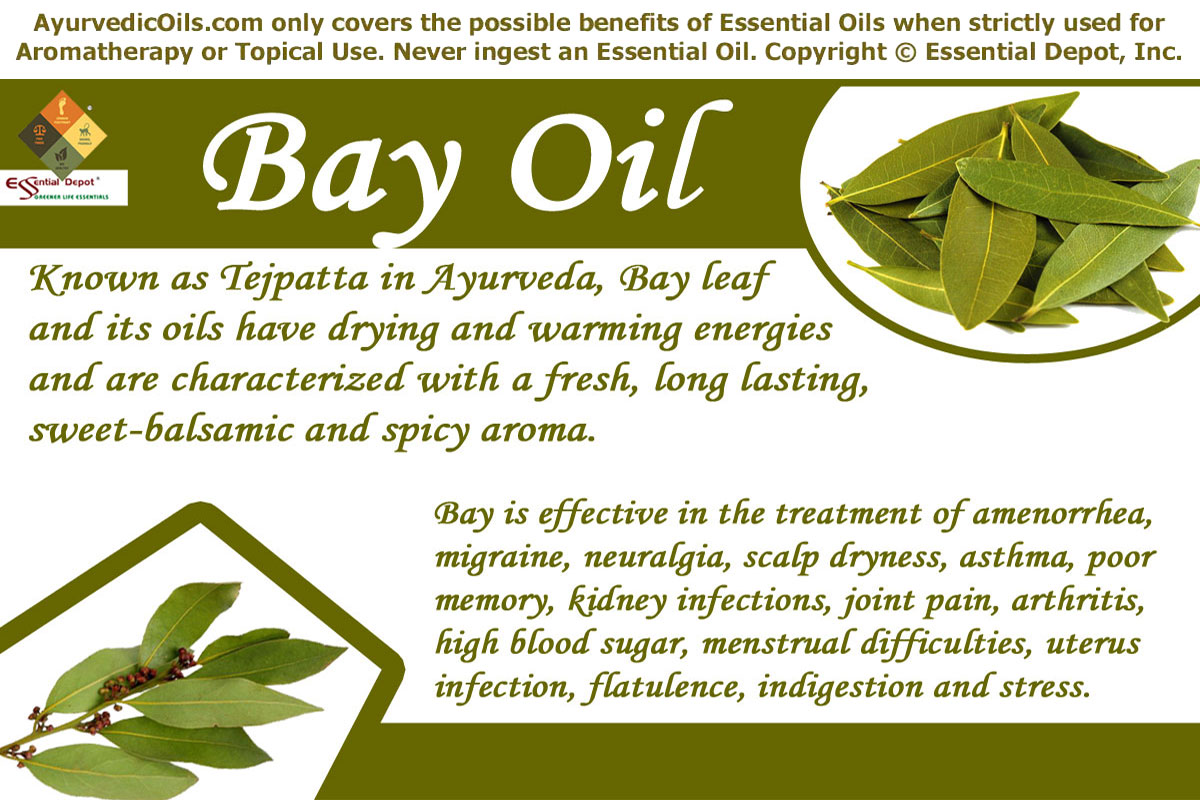
The energy of being able to feel the new fragrance of the dewfall from a rose petal is the symbol of being hale and hearty. Bay leaf and its essential oil is another gift of nature that can help one in attaining this absolute state of health and heartiness.
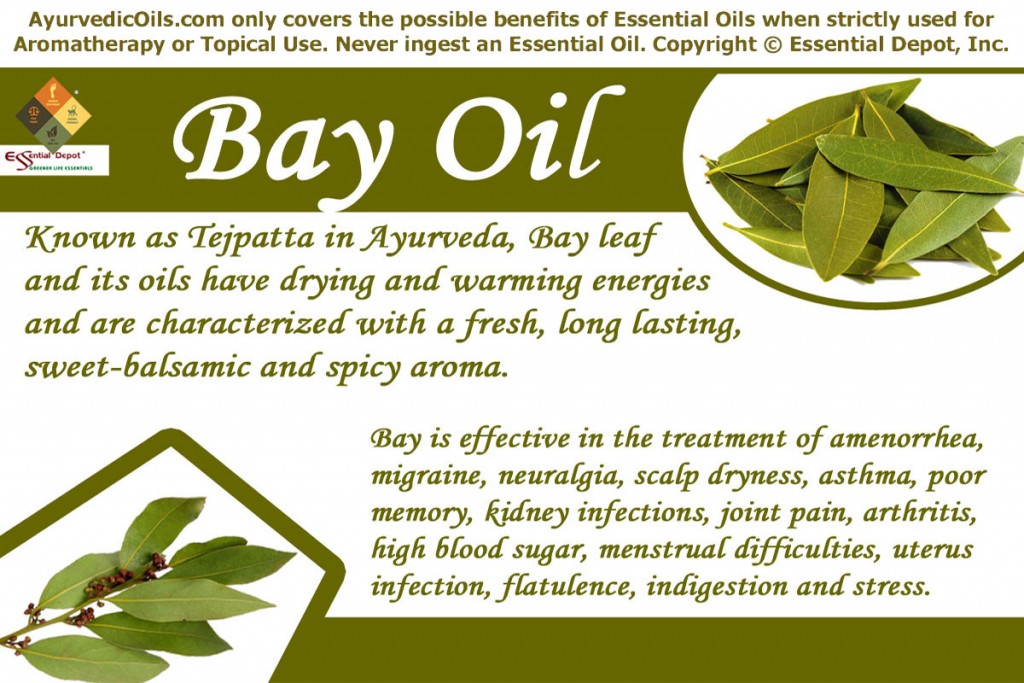 Being a stimulant of the digestive system, respiratory passages, circulatory system and the lymphatic functions, Bay leaf has been a trusted traditional remedy for keeping numerous health conditions at bay.
Celebrated as an aromatic culinary spice all over the world, Bay leaf is one among the most important ingredient of the garam masala and the authentic Biriyani, the much relished dish of the world from the Mughal Empire.
Botanically called as Laurus nobilis (Mediterranean Bay leaf), Bay leaf is known as Tejpatta (Indian Bay leaf or Cinnamomum tamala) in Ayurveda, and it has been used in the treatment of scalp dryness, migraine, amenorrhea, neuralgia, headache, asthma, poor memory, kidney infections, joint pain, uterus infection, arthritis, high blood sugar, menstrual difficulties, flatulence, stress, indigestion, diabetes and certain respiratory problems.
Purchase Bay Essential Oil – Retail – 4 oz – CLICK HERE
Historical uses and importance of Bay leaf and its essential oil:
Bay leaves generally refer to various aromatic leaves of several plants used for culinary purposes. These names are given based on their nativity and few notable Bay leaf varieties are Bay laurel or Laurus nobilis, which is of Mediterranean origin; the next is the Indian Bay leaf or Cinnamomum tamala; West Indian Bay leaf or Pimenta racemosa; Indonesia Bay leaf or Syzygium polyanthum; Mexican Bay leaf or Litsea glaucescens; and the California Bay leaf or Umbellularia californica.
Every variety of Bay leaf has its own fragrance and numerous uses in cooking and in remedial practices for more than thousands of years across the globe. Whole leaves and powdered leaves are often used in adding that unique flavor in food preparation, where as the infusion or decoction of these leaves and its essential oil play a vital role in the Traditional and Alternative healing methodology.
Held high as the Sun God in Astrology, Bay laurel tree and its leaves have been related to wisdom, protection and peace since the primeval times, where the wise King was honored with the garland made of Bay leaves. This is mainly due to the positive emotional benefits of Bay leaves that aid in treating anxiety, stress and insomnia.
The powdered Bay leaves were mixed with milk for treating urinary infections, fever and dyspepsia. It was also recommended for normalizing blood circulation and reducing bad cholesterol in the system. The fresh and dried Bay leaves were used in the preparation of an herbal infusion, which was used as a promising diuretic for promoting frequent urination; eliminate excess water from the body and toxic remains in the system causing rheumatic conditions, indigestion, obesity and even heart problems.
Bay leaves were a trusted remedy in the Indian folklore medicine for treating vomiting, fatigue, nausea, diarrhea, rheumatism, obesity and colic. These magical leaves were also used as an aid for preventing cancer and oral problems. It is also used in the preparation of soups, stews, curries, liqueurs, anti-dandruff shampoos and cologne.
Bay leaf essential oil has been recommended in treating dandruff, rheumatism, migraine pain, arthritis, high blood pressure, congestion and earache. The astringent and anti-bacterial properties of this leaf supports its use as a salve for wounds and was used in the traditional medicine for treating skin rashes due to stinging nettle, poison ivy etc.,
Chemical constituents and therapeutic properties of Bay leaf essential oil:
The most notable therapeutic values of Bay leaf essential oil are anti-bacterial, antifungal, diuretic, stomachic, emmenagogue, tonic, febrifuge, diaphoretic, sedative, astringent, appetite stimulant, anti-neuralgic, expectorant, insecticide, anti-cancer, anti-inflammatory, cholagogue, antibiotic, aperitif and sudorific.
These remedial properties are due to the presence of effective chemical constituents in Bay essential oil including eucalyptol or cineole, linalool, limonene, eugenol, a-terpineol, geraniol, phellandrene, myrcene, a-pinene, b-pinene, neral, chavicol, and geranyl acetate.
Ayurvedic health benefits of Bay essential oil:
Ayurveda is the oldest medicinal science known to the world with more than 5,000 years of successful healing. It is a vital part of the ancient Indian Hindu mythology, which contains a compilation of 4 major Holy books called as Vedas.
They are Rig, Sama, Atharvaveda and Yajur Vedas. Between them, Ayurveda is a component of the Atharvaveda, in which 114 verses indicate the all-embracing Ayurvedic philosophy and natural remedies to guide a healthy and hearty living.
The world of Ayurveda attained its wholesomeness with the writings of the Ayurvedic physicians like Charaka (regarded as the ‘Father of medicine’) and Sushruta (known to the world as the ‘Father of surgery’). Acharya Charaka composed Charaka Samhita and Sushruta wrote Sushruta Samhita respectively, which was later combined together and gifted to the world of medicine in the name of Ashtanga Hridaya Samhita.
Ayurvedic healing insists on the importance of leading a healthy life with absolute physical, mental, social and spiritual balance. For attaining this, Ayurveda advises on leading a healthy lifestyle and balanced food habits along with other routine tasks like simple physical exercises, meditation, yoga, prayers and natural remedies like herbs and Ayurvedic essential oils.
As a holistic healing methodology, Ayurveda has everything including disciplinary values for increased life span and attaining bliss while on earth itself. With these respectable principles, Ayurveda aims at preventing illnesses rather than just healing. It believes that the adherence to Ayurvedic lifestyle and healthy habits can aid in preventing lifestyle disorders like high blood pressure, fatty liver conditions, high cholesterol, heart diseases, obesity, kidney degeneration and diabetes etc.
Ayurveda strongly believes that everything on earth including mankind is made up of the five basic elements of nature. They are earth, fire, space, air and water. It further states that every individual is a unique creation with a unique individual constitution, which is made of three biological energies known as doshas. They are vata, pitta and kapha.
Vata dosha is a combination of air and space and is responsible for the circulatory and nervous functions of the system. Pitta is made up of fire and water and is in charge for the metabolic functions and body temperature. Kapha is a mix of water and earth and is accountable for the functions of the reproductive system, sustenance and physique.
According to Ayurveda, every person has a predominance of one of these doshas and it decides the personality, behavior and character of an individual. Balance between these doshas as per the law of nature indicates perfect health and doshic disparities due to change in food habits, lifestyle and climatic conditions leads to illnesses.
Ayurveda prescribes natural remedies and Ayurvedic techniques like Abhyanga or the art of Ayurvedic massaging, Panchakarma or the detox techniques, Pranayama or balanced breathing etc., for correcting the imbalance of doshas.
With its drying and warming energies along with its fresh, long lasting, sweet-balsamic and spicy aroma, Bay leaf essential oil is said to pacify kapha and vata dosha and aggravate pitta dosha.
Let’s take a look at the Ayurvedic health benefits of Bay leaf essential oil:
 1. Promising remedy for diabetes and other lifestyle disorders:
Bay leaf essential oil has numerous remedial properties that help in the treatment of diabetes and other lifestyle health problems like fatty liver conditions, high blood pressure, obesity and kidney degeneration.
A 2009 study on ‘Bay leaves Improve Glucose and Lipid Profile of People with Type 2 Diabetes’ by the Department of Human Nutrition, NWFP Agricultural University, Peshawar, Pakistan published in the “Journal of Clinical Biochemistry and Nutrition” analyzed the effects of blood sugar on human beings with Type 2 diabetes.
Among the participants who were given about 1 to 3 grams of ground Bay leaf per day in this program for 30 days, reflected a significant fall in the level of blood glucose, triglycerides and cholesterol. This research concluded that “Bay leaves reduced serum glucose, total cholesterol, LDL cholesterol and triglycerides, and increased HDL cholesterol levels in people with type 2 diabetes.”
The antioxidant and anti-diabetic properties of Bay leaf promotes the system in the progression of insulin effectively. The most amazing result of this study was that it also helped in reducing the level of cholesterol and triglycerides, which also assists in reducing the menace of cardiovascular disorders due to enhanced insulin function.
Another study in 2011 on “The effects of Bay leaves on the patients with Diabetes Mellitus” by Abdulrahim Aljamal conducted on 65 patients with Type2 diabetes witnessed that “this study group using Bay leaf supplementation for 4 weeks decreases the risk factors for diabetes and cardiovascular diseases by reducing blood glucose and lipids levels.”
It was also explained that diabetes mellitus is one among the major risk factors for cardiovascular problems, where the occurrence of such disorders are increased 2 to 4 times in people with diabetes. He also says “Diabetes is a chronic disorder of glucose metabolism resulting from dysfunction of pancreatic beta cells and insulin resistance.”
Skin is the largest organ of the human body and it transmits the remedial values of Ayurvedic essential oils quickly into the bloodstream, thus speeding up the healing process. You can either use Bay leaf oil in a massaging blend or your bath for treating diabetes.
Make your home the heaven of Ayurvedic spa in the weekend by massaging your system with 5 drops of Bay leaf oil, 5 drops of Clove oil, 5 drops of Cinnamon oil and 5 drops of Rosemary oil along with 10 ml of Olive oil, followed by a refreshing bath diluted with 1 drop of Bay leaf oil and 1 drop of Lavender oil. This can absolutely help in augmenting your insulin function and support in reducing your blood glucose, lipids and cholesterol levels.
2. Helps in healing wounds quickly:
Bay leaf is nature’s blissful gift for healing wounds and skin infections at ease. With its anti-fungal, anti-bacterial and antiseptic properties, the fresh and dried leaves along with the essential oil have been in use in healing wounds, scars, bruises, cuts, insect bites and minor skin allergies. Bay leaves were used in folklore medicine as a remedy for venomous snake bites, poisonous stings and bites.
Open wounds are always viable for catching up with bacteria, virus and fungus, which ends up in septic of wounds and serious infections, leading to sharp pain, convulsions, cramps and hydrophobia. The poultice made using Bay leaves were used by various herbalists for disinfecting and healing wounds.
A 2011 study published in the Natural product research journal proved that Bay leaves contain antimicrobial activity that combats the growth of bacteria and general pathogens like Aspergillus fumigatus, Staphylococcus aureus, Candida albicans and Streptococcus pyogenes. Among these, Staphylococcus aureus is considered to be the most harmful bacteria responsible for wounds becoming septic.
Bay leaf is rich vitamin A & C, which are extremely good for healthy skin. It enhances the healthiness of the skin from within by helping in retaining its natural beauty. Gently massaging your skin with 2 drops of Bay leaf oil with 2 drops of Petitgrain oil, 2 drops of Lavender oil along with 3 ml of jojoba oil can give that charisma for your skin by reducing wrinkles, cleansing the pores deeply, treating acne, stretch marks, scars, eczema and covering up the other skin outbreaks.
2 drops of Bay leaf oil with 2 drops of Rosemary oil and 2 ml of coconut oil can be applied on wounds and other skin infections for promoting quicker healing and arresting the growth of hazardous microbial infections.
3. Improves digestion and other metabolic functions:
The aromatic leaves and its essential oil of Bay are famous as a digestive aid, especially in the Asian, Middle East and Mediterranean countries. Ayurveda states that Bay leaf has heating energies that aids in augmenting Agni or the digestive fire, which is responsible for trouble-free metabolic functions.
Bay leaf is called as a pitta aggravating spice and herb, where pitta dosha deals with metabolism. Digestive disorder or problems due to pitta deficiency are balanced with the help of Bay leaves and its various extracts.
With its carminative, anti-flatulent, stomachic and cholagogue properties, Bay leaf oil helps in expelling the excess gas in the stomach and intestines. The stimulating effect of this oil boosts the metabolic functions and helps relieve digestive problems like colic, flatulence, diarrhea, bloating, intestinal spasms and ulcers.
Massaging your stomach with 2 drops of Bay oil blended with 2 drops of Geranium oil and 2 drops of Lemon oil along with 3 ml of Sesame oil can assist in promoting the secretion of gastric acids, digestive juices, enzymes and bile, which aids in neutralizing surplus acids in the lining of the stomach and intestines, thus preventing ulcers.
Along with this massaging, inhaling the encouraging aroma of Bay oil in a diffuser by adding 2 drops of this oil can strengthen your digestive system and support hassle-free metabolism.
4. Alleviates respiratory illnesses:
Bay leaf oil has excellent warming energy that assists in relieving from illnesses caused due to excess water deposits, which otherwise leads to the amassing of mucus and phlegm in the system. Generally respiratory illnesses are caused mainly due to the imbalance of kapha dosha and vata dosha in cases of breathing difficulties faced in asthmatic attacks.
Bay oil has been trusted as a natural source of reducing excess of kapha and vata dosha. This helps in the treatment of congestion, buildup of phlegm in the lungs and nasal passages, bronchitis, whooping cough and cold.
In their book Ayurveda and Aromatherapy, Bryan Miller and Light Miller say “Bay can be useful for the respiratory tract, also easing congestion or colds, especially in combination with Eucalyptus and Rosemary.”
2 drops of Bay oil and 2 drops of Tulsi oil added to steam inhalation is a great assistance for loosening stiff phlegm and mucus deposits in the breathing passages, asthma, nasal congestion, stiff nose, watery eyes, cough, common cold, headache and other respiratory allergies.
Mixing 2 drops of Bay oil with 2 drops of Eucalyptus oil and 2 drops of Rosemary oil in your vaporizing ointment and gently massaging it on your chest, throat and back is a brilliant way to treat your respiratory infections including asthmatic attacks at ease.
This is attributed mainly by the expectorant, anti-bacterial, anti-viral, decongestant, immune stimulant and tonic properties of these essential oils that strengthen the immune system and help it fight against respiratory disorders.
5. Supports healthy hair and scalp:
The most interesting healing attribute of Bay leaf oil is that it assists in controlling hair fall and promotes hair growth. In the traditional Ayurvedic medicine, a herbal rinse prepared by infusing Bay leaves was used in the treatment of dandruff and dry scalp.
Bryan Miller in the book Ayurveda and Aromatherapy reveals Light Miller’s preferred hair treatment with Bay oil. He says “Light’s favorite use of Bay oil is to add it to hot oil treatment for the hair. To two ounces of Jojoba oil, add 4 drops of Bay, 3 drops of Lavender, 3 drops of Lemon, 3 drops of Rosemary, 3 drops of Rosewood oil and a tablespoon of Sesame oil.”
He further adds “Heat the mixture and apply to the hair while warm, wrap your head in a towel and sit for fifteen minutes to half an hour. Shampoo clean. Bay is also very effective for dry scalp and hair; you may add it to shampoo and cream rinses.”
2 drops of Bay oil with 2 drops of Bhringraj oil, 2 drops of Amla oil and 2 drops of Neem oil added to 5 ml of Sweet almond oil can be massaged on the hair roots, for stimulating the growth of lustrous, black, healthy and strong hair and getting rid of dandruff and head lice.
6. Relieves rheumatic and arthritic conditions:
Bay leaves have anti-rheumatic, anti-arthritic, analgesic, anti-inflammatory and antioxidant effects, which aid in treating rheumatic and arthritic conditions. Rheumatism is again a kapha disorder, where excess of water deposits get stagnated in the system, especially in the joints. This causes pain, swelling, inflammation, redness, lack of energy, and buildup of toxic substances and free radicals.
Bay leaf oil has warming and drying energies that helps in reducing pain by generating heat in the affected parts and eliminating the toxic remains and surplus water content in the system through urine. The diuretic and sudorific properties in this oil promotes sweating and urination and is a natural remedy for discarding free radicals, ama or toxic substances, uric acid, salt and other excess water deposits.
Massaging the painful area with 4 drops of Bay leaf oil with 3 drops of Lavender oil and 3 drops of Cinnamon oil along with 5 ml of Coconut oil can aid in alleviating pain and sprain, and in reducing inflammation, irritation, redness, painful joints and sore muscles.
7. Effective inhibitor of cancerous cells:
Many scientific studies have proved the effects of Bay leaf in treating various types of cancer with its chemo-protective properties, contributed by the presence of quercetin, catechins, quercetin and eugenol.
Various research reports have established that Bay leaves control the production of cervical cancer cells with the presence of a phytonutrient named parthenolide. Another study have explored that the chemical component lauroside B extracted from Laurus nobilis inhibits the generation of skin cancer or human melanoma cells.
Other benefits:
Bay oil can also be used as an effective repellent against cockroaches, moths, silverfish, mice etc., It is also helpful in treating dental infections and circulatory problems.
Disclaimer:
This article is only for the purpose of education and is not meant for treatment, prevention or diagnosis of any health condition. It should not be used as a replacement for prescription drugs or any expert medical advice. We are not medical professionals and this piece of information is intended only for sharing the traditional richness of Ayurveda, the mother of all medicinal systems on earth.
Internal use of essential oils should be strictly avoided and make sure that you dilute essential oils before using it for topical application, as pure and organic essential oils are highly concentrated liquids and may cause allergies if used on the skin directly. Speak with your Ayurvedic physician or healthcare expert before selecting the appropriate essential oils for your prakriti or unique individual constitution and your medical condition.
Bay oil is emmenagogue in nature and may induce menstruation so it is not advisable for use for pregnant women. Keep it out of reach of children.
The MSDS (Material Safety Data Sheet) of Bay oil is readily available for your enhanced safety and better usage.
Bay Oil – Possible Skin Issues:
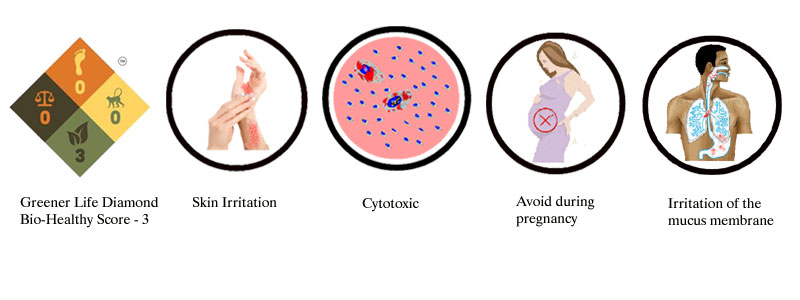
Greener Life Diamond – Bio-Healthy Score => 3: Possible Skin Issues:
See => http://www.essentialdepot.com/GreenerLifeDiamond.html
Bay oil is said to exhibit irritation, sensitization, hepatoxicity and cytotoxicity. Topical application and inhalation of this oil might cause allergies, skin irritation, sensitization in pregnant women, children and nursing mothers, arrest blood clotting and irritate the mucous membranes. It is recommended to avoid Bay oil during pregnancy, even in a diluted form, as it may cause harm to the developing fetus.
The key chemical constituents responsible for the possible skin issues of Bay oil are eugenol and methyleugenol. Besides being an excellent decongestant and antiseptic, eugenol in undiluted Bay oil can cause rashes, itching, irritation of the skin and the mucous membranes, when applied as a decongesting ointment or during inhalation of the concentrated oil.
Remember to dilute Bay oil in suitable carrier oils and 10% is the recommended safe dilution level. Always perform a patch test on your skin before using Bay oil for dermatological purposes.
Numerous studies state that Bay oil has Cytotoxic effects, which means the potent of being toxic or deadly to cells. For this effect, Bay oil is used therapeutically in Apoptosis or a genetic line up for controlled cell death, especially in the treatment of Cancer. Chemotherapy (treatment of cancer) solely depends upon the potential of cytotoxic remedies to destroy the existing cancerous cells and thwart the rapid reproducing ability of cancer cells (Antiproliferative ability).
According to the European Commission’s scientific committee opinion on Food on Methyleugenol, it displays genotoxic and carcinogenic effect and it does not hold good for topical or external use of Bay oil.
Bay leaf is often misconceived as toxic as it is confused with other members of the Laurel family like Mountain Laurel, Cherry Laurel, which are potential toxic agents.
This warning is applicable to direct skin applications like lotions, balms, massage oils and creams and not for bathing products like soaps and shampoos.
Reference Links Substantiating Possible Skin Issues of Bay oil:
- Leung’s Encyclopedia of Common Natural Ingredients, used in Food, Drugs and Cosmetics by Ikhlas A. Khan and Ehab A. Abourashed.
- Bay oil by Mercola.com
- Opinion of the Scientific Committee on Food on Methyleugenol by the European Commission, Health and Consumer Protection Directorate-General
- Aromatherapy: Scent and Psyche: Using Essential Oils for Physical and Emotional Well-Being by Peter Damian and Kate Damian
- Cytotoxic effect of Laurus nobilis extracts on different cancer cell lines by Zaynab Saad Abdel Gany, Iraqi Center for Cancer and Medical Genetics Researches
Thought for the day:
Nature and books belong to the eyes that see them.
-Ralph Waldo Emerson
Suggested Reading:
- Ayurveda & Aromatherapy: The Earth Essential Guide to Ancient Wisdom and Modern Healing by Dr. Light Miller, Dr. Bryan Miller
- God’s Healing Herbs by Dennis Ellingson
- The Illustrated Encyclopedia of Essential Oils: The Complete Guide to the Use of Oils in Aromatherapy & Herbalism by Julia Lawless
- Functional Foods, Aging, and Degenerative Disease from CRC Press
- Therapeutic Blending With Essential Oil: Decoding the Healing Matrix of Aromatherapy by Rebecca Park Totilo
Reference Links:
- Bay Leaf by Wikipedia
- Bay Leaves Improve Glucose and Lipid Profile of People with Type 2 Diabetes by Alam Khan, Goher Zaman and Richard A. Anderson, published in the Journal of Clinical Biochemistry and Nutrition
- Effects of Bay leaves on the patients with Diabetes mellitus by Abdulrahim Aljamal, published in the Research Journal of Medicinal plant
- Scientifically proven health benefits of Bay leaf oil published in the Planet of health

Your resource for quality Essential Oils. Every batch is
GC tested to ensure purity and authenticity.